
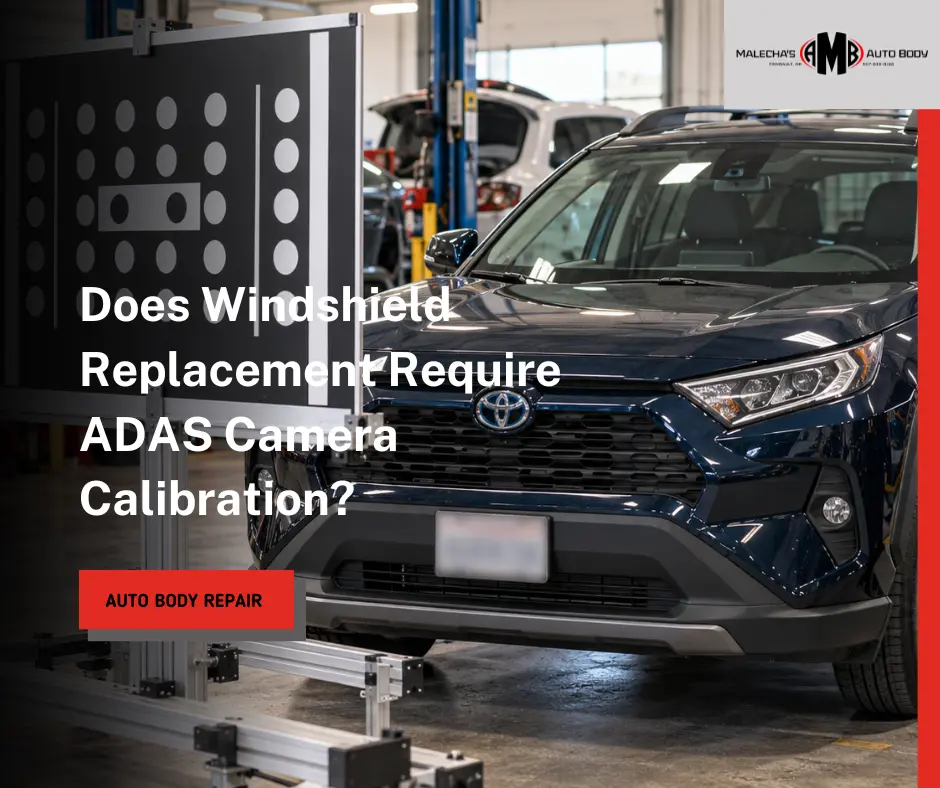
SUMMARY
- Windshield replacement can require ADAS camera calibration, but the requirement depends on the vehicle, its equipment, and the manufacturer’s procedures.
- Many modern vehicles use a forward-facing camera mounted near the top of the windshield for driver-assistance features.
- Replacing the windshield can change the camera’s relationship to the road, vehicle, or glass, which is why manufacturers may specify calibration after replacement.
- ADAS features connected to a windshield-mounted camera can include automatic emergency braking, forward collision warning, lane departure warning, and lane keeping assistance, depending on the vehicle.
- Calibration requirements should be determined from the specific year, make, model, trim, equipment, and manufacturer procedures, not by assuming every vehicle follows the same process.
- A diagnostic scan and an ADAS camera calibration are different procedures. Clearing a warning or diagnostic trouble code is also not the same as calibration.
- Depending on the manufacturer, camera calibration may involve a static procedure, dynamic procedure, or combination of both.
- A vehicle may not display an obvious dashboard warning even when manufacturer procedures call for calibration.
- Windshield installation, camera mounting, wheel alignment or vehicle geometry prerequisites, tire pressure, and other conditions can matter for certain calibration procedures.
- Drivers in Faribault can discuss collision-related windshield and ADAS concerns with Malecha’s Auto Body at 190 20th St NW, Faribault, MN 55021.
Does Every Windshield Replacement Need ADAS Calibration?
No.
Not every vehicle has a windshield-mounted ADAS camera, and not every windshield replacement follows the same procedure.
The correct question is:
Does the manufacturer require calibration for this specific vehicle after windshield replacement?
That answer can depend on:
- Year
- Make
- Model
- Trim
- Installed equipment
- Camera type
- Windshield replacement procedure
- Manufacturer instructions
This is why technicians should research the vehicle rather than make a universal assumption.
The I-CAR Repairability Technical Support Portal provides collision repair professionals with manufacturer-specific information and resources related to repair procedures, including ADAS considerations.
What Is an ADAS Camera?
ADAS stands for Advanced Driver Assistance Systems.
Modern vehicles can use cameras, radar sensors, ultrasonic sensors, and other technologies to support driver-assistance features.
The National Highway Traffic Safety Administration provides information about technologies such as:
- Forward collision warning
- Automatic emergency braking
- Lane departure warning
- Lane keeping assistance
- Blind spot warning
The exact systems installed depend on the vehicle.
A forward-facing camera is commonly located near the upper portion of the windshield, often around the rearview-mirror area.
Why Is a Camera Mounted to the Windshield?
The camera needs a view of the road ahead.
Depending on the vehicle, information from the camera may be used to recognize things such as:
- Lane markings
- Vehicles ahead
- Road conditions or objects relevant to supported systems
The camera’s location and orientation are therefore important.
That becomes relevant when the windshield is replaced.
Step 1: Determine Whether the Vehicle Has a Windshield Camera
Before discussing calibration, first determine whether the vehicle actually has an applicable camera.
Look around the area behind the rearview mirror.
You may see a housing containing a camera or other sensors.
However, appearance alone should not be the final answer.
Equipment can vary between vehicles that otherwise look nearly identical.
Technicians can use vehicle information and manufacturer documentation to determine what systems are installed.
Step 2: Identify the Exact Vehicle
The same model can have different equipment depending on:
- Model year
- Trim level
- Optional packages
- Production configuration
One version may have a forward-facing camera while another may not.
This is why the vehicle’s VIN and equipment information can be important when researching repair and calibration requirements.
Step 3: Check the Manufacturer’s Windshield Replacement Procedure
Once the vehicle and equipment are identified, the next question is:
What does the manufacturer require after the windshield is replaced?
The answer should come from the applicable repair information.
Manufacturer procedures may specify calibration after:
- Windshield replacement
- Camera removal
- Camera replacement
- Camera disturbance
- Other specified repairs
The triggers vary by manufacturer and vehicle.
Malecha’s Auto Body provides information about its OEM certifications and the role manufacturer-specific procedures can play during collision repair.
Why Can Windshield Replacement Affect Camera Calibration?
A windshield-mounted camera depends on a specific relationship between the camera, vehicle, glass, and road ahead.
During windshield replacement, components around the camera may need to be:
- Removed
- Disconnected
- Repositioned
- Reinstalled
The glass itself is also being replaced.
Depending on the vehicle, these changes can trigger a manufacturer-specified calibration procedure.
Can the Camera Look Correct but Still Need Calibration?
Yes.
Visual appearance alone does not determine whether calibration is required.
A camera may appear to be:
- Properly attached
- Centered
- Undamaged
and the manufacturer may still require calibration after windshield replacement.
The requirement is procedural, not simply based on whether someone can visually see a problem.
Does the Camera Have to Be Damaged Before Calibration Is Needed?
No.
Calibration and repair are different concepts.
A camera can remain physically undamaged while its position has been affected by:
- Removal
- Reinstallation
- Windshield replacement
- Mounting changes
If the manufacturer specifies calibration after the procedure, the camera does not need to be visibly broken for that requirement to apply.
Step 4: Understand Static Camera Calibration
Some vehicles use static calibration.
The vehicle remains stationary while technicians perform a manufacturer-specified procedure.
Depending on the vehicle, the process can involve:
- Calibration targets
- Precise measurements
- Specified distances
- Vehicle positioning
- Diagnostic equipment
The exact setup is vehicle-specific.
Technicians should not assume that target placement for one vehicle applies to another.
Why Does Static Calibration Require Precise Setup?
The procedure may depend on accurately establishing the relationship between:
- Vehicle
- Camera
- Calibration target
If the manufacturer specifies particular measurements, those measurements matter.
Even small setup differences can affect whether the procedure can be completed according to the required process.
Step 5: Understand Dynamic Camera Calibration
Other vehicles can use dynamic calibration.
This generally involves driving the vehicle under specified conditions while diagnostic equipment communicates with the ADAS system.
Depending on manufacturer instructions, requirements may involve factors such as:
- Vehicle speed
- Road type
- Lane markings
- Weather
- Traffic conditions
- Driving distance
These requirements vary.
A dynamic calibration should not simply be interpreted as:
“Drive the car around for a few minutes.”
The manufacturer’s procedure determines what conditions are required.
Step 6: Understand Combined Calibration
Some vehicles may require both:
- Static calibration
- Dynamic calibration
If both appear on a repair plan or invoice, do not automatically assume one is unnecessary.
Ask:
- Which procedures does the manufacturer require?
- What system is being calibrated?
- Why are both procedures necessary?
The answer should relate to the specific vehicle.
Is a Diagnostic Scan the Same as Camera Calibration?
No.
This is one of the most important distinctions for vehicle owners to understand.
A diagnostic scan communicates with electronic control modules and may retrieve information such as:
- Diagnostic trouble codes
- Module information
- System faults
Calibration establishes or verifies the applicable ADAS component according to the required procedure.
A scan does not automatically perform a calibration.
A calibration does not automatically replace every required scan.
Can a Shop Just Clear the ADAS Warning Light?
Clearing a warning or diagnostic trouble code is not the same as completing a required calibration.
If the manufacturer specifies calibration after windshield replacement, clearing a code does not replace that procedure.
The repair process should address the reason the procedure is required.
What if There Is No Warning Light?
The absence of a warning light does not automatically mean calibration is unnecessary.
Some calibration requirements are triggered by a repair operation, such as windshield replacement, rather than by a dashboard warning.
That is why manufacturer procedures matter.
Do not rely solely on whether a warning appears.
Step 7: Make Sure the Windshield Installation Is Complete First
Calibration cannot compensate for an unresolved physical installation problem.
The windshield and applicable camera mounting components need to be properly installed before calibration is used to complete the required ADAS procedure.
Calibration is not a way to fix:
- Incorrectly installed glass
- Damaged camera bracket
- Broken mounting component
- Unresolved body damage
Physical problems must be addressed appropriately.
Can the Type of Replacement Windshield Matter?
The replacement glass needs to be appropriate for the vehicle and its installed equipment.
Modern windshields can incorporate features or areas related to:
- Cameras
- Sensors
- Heating elements
- Other vehicle-specific equipment
The correct part should be identified for the vehicle.
Windshield selection should not be based on dimensions alone.
Step 8: Check the Camera Mounting Area
Depending on the vehicle, the forward-facing camera may attach to a bracket associated with the windshield.
The mounting area matters because the camera must be positioned as intended by the vehicle manufacturer.
If a bracket or mounting component is:
- Damaged
- Loose
- Incorrect
- Improperly positioned
Calibration should not be treated as a way to hide that physical problem.
Step 9: Consider Collision Damage Around the Windshield
Sometimes a windshield is being replaced because of a collision rather than an isolated glass crack.
In that situation, technicians may need to consider more than the glass.
Depending on the impact, areas that could warrant evaluation include:
- Roof
- A-pillars
- Cowl area
- Windshield opening
- Camera mounting area
The presence of a cracked windshield does not by itself prove that these areas are damaged.
They should be evaluated based on the collision evidence.
For vehicles involved in an accident, professional collision repair involves evaluating the damage beyond what is immediately visible.
Step 10: Do Not Assume Calibration Fixes Collision Damage
Suppose a collision affected the windshield opening or surrounding structure.
Running a camera calibration does not straighten damaged metal.
Likewise, calibration cannot repair:
- Bent body components
- Damaged brackets
- Suspension damage
- Steering damage
- Incorrect glass installation
Physical repairs and calibration serve different purposes.
Can Wheel Alignment Affect ADAS Calibration?
For some vehicles and calibration procedures, vehicle geometry or alignment-related conditions can matter.
But this does not mean every windshield replacement automatically requires a wheel alignment.
Manufacturer procedures should determine whether alignment measurements or other geometry-related prerequisites apply.
Avoid universal rules.
Step 11: Check Tire Pressure When Required
Some calibration procedures specify vehicle preparation conditions.
Depending on the manufacturer, technicians may need to verify items such as:
- Tire pressure
- Vehicle loading
- Fuel level
- Steering position
- Ride height-related conditions
These requirements vary.
The goal is to place the vehicle in the condition specified by the calibration procedure.
Step 12: Calibration Environment Can Matter
Static calibration may require specific shop conditions.
Depending on manufacturer requirements, technicians may need to consider:
- Floor level
- Space around the vehicle
- Target positioning
- Lighting
- Vehicle position
- Surrounding objects
This is another reason ADAS calibration is more involved than simply connecting a scan tool.
Why Does the Floor Matter?
Certain static calibration procedures rely on measurements between the vehicle and calibration targets.
If the manufacturer specifies a particular setup, the environment becomes part of the procedure.
The shop needs to follow the requirements that apply to the vehicle being serviced.
Step 13: Understand the Role of OEM Procedures
ADAS technology is not identical across all vehicles.
A Honda procedure may differ from a Subaru procedure.
A newer model may differ from an older model.
Even vehicles from the same manufacturer can have different systems.
That is why repair professionals research the specific vehicle rather than relying on a single universal ADAS process.
Does Every Auto Glass Company Perform Calibration?
Not necessarily.
Some glass companies may perform calibration themselves.
Others may coordinate it with another provider.
If your vehicle requires calibration, the important questions are:
- Who will perform it?
- What procedure is required?
- When will it be completed?
- What documentation will be available?
Ask these questions before assuming windshield replacement is finished.
Step 14: Ask Whether Calibration Is Included in the Estimate
Before authorizing windshield-related repairs, review the estimate.
If the vehicle requires ADAS calibration, ask whether the calibration appears on the repair plan.
You can ask:
- Which camera needs calibration?
- What triggered the requirement?
- Is it static, dynamic, or both?
- Who performs the procedure?
- Is it included in the estimate?
Clear questions can prevent confusion later.
Step 15: Ask About Calibration Documentation
When calibration is completed, ask what documentation is available.
Depending on the equipment and procedure, documentation may identify information such as:
- Vehicle
- VIN
- Calibration procedure
- System calibrated
- Date
- Result
Report formats vary.
Keep available calibration documentation with your repair records.
Step 16: Ask About Diagnostic Scan Documentation
If diagnostic scans were performed as part of a collision repair, ask whether those reports are available as well.
Remember:
Scan report ≠ calibration report.
They document different procedures.
A complete repair file can contain both.
Step 17: Pay Attention to Your Vehicle After Windshield Replacement
After receiving the vehicle, watch for:
- ADAS warning lights
- Camera unavailable messages
- Lane-assistance warnings
- Forward-collision system warnings
- Other new system messages
If something appears that was not present before the repair, contact the repair provider.
Do not attempt to manually reposition the camera yourself.
What if the ADAS System Seems to Work Normally?
That is useful information, but it does not replace checking manufacturer requirements.
A driver cannot necessarily determine calibration status simply by driving the vehicle and seeing whether a warning appears.
If calibration was required, ask whether it was completed and documented.
Step 18: Remember That ADAS Is Driver Assistance
Even when correctly calibrated, driver-assistance technology does not replace attentive driving.
NHTSA describes these technologies as systems designed to assist drivers.
Drivers remain responsible for controlling their vehicles and responding to road conditions.
ADAS should never be treated as an excuse to stop paying attention.
What if the Windshield Only Has a Small Crack?
A small crack does not automatically mean the windshield must be replaced.
The appropriate solution can depend on:
- Crack size
- Location
- Extent of damage
- Glass condition
- Other applicable factors
If the windshield is repaired rather than replaced and the camera is not disturbed, the calibration requirements may be different.
Again, vehicle-specific procedures should guide the decision.
Does Windshield Repair Require Calibration?
Not automatically.
A small glass repair and complete windshield replacement are different procedures.
Whether any ADAS procedure is required depends on:
- Vehicle
- Camera location
- Work performed
- Manufacturer instructions
Do not apply the windshield replacement rule to every small chip repair.
What if the Windshield Was Replaced After an Accident?
Then the repair should be considered in the context of the entire collision.
For example, a front or upper-body impact may involve more than glass.
Depending on the damage, auto body repair may need to address surrounding components before calibration becomes relevant.
The correct sequence matters:
- Evaluate the collision damage
- Repair applicable physical damage
- Complete windshield installation
- Perform applicable diagnostic and calibration procedures
- Complete final checks
The exact process varies by vehicle and repair.
Can an Insurance Claim Include ADAS Calibration?
If calibration is required as part of covered windshield or collision repairs, it may appear in the repair estimate or claim documentation.
Insurance coverage depends on:
- Policy
- Loss
- Repair
- Applicable coverage
Do not assume every policy handles glass replacement or calibration the same way.
For insurance questions, review your policy and communicate with your insurer and repair provider.
Should You Choose a Repair Facility Based Only on Calibration Price?
Price matters, but it should not be the only question.
Ask:
- Does the vehicle require calibration?
- How was that requirement determined?
- Which procedure applies?
- Is the correct equipment available?
- Are manufacturer procedures being followed?
- Will documentation be provided?
The cheapest calibration is not useful if it is not the procedure your vehicle requires.
What Should Faribault Drivers Ask Before Windshield Replacement?
Use this checklist:
- Does my vehicle have a windshield-mounted ADAS camera?
- Does the manufacturer require calibration after replacement?
- Which ADAS system uses the camera?
- What replacement windshield is appropriate for my vehicle?
- Will the camera or bracket be removed or disturbed?
- Is calibration static, dynamic, or both?
- Who will perform the calibration?
- Is calibration included in the estimate?
- Will I receive documentation?
- Are any other collision repairs required first?
You do not need to become an ADAS expert.
You simply need clear answers about what applies to your vehicle.
Frequently Asked Questions
Does every windshield replacement require ADAS camera calibration?
No. The requirement depends on the vehicle, its equipment, the work performed, and manufacturer procedures. Vehicles without an applicable windshield-mounted camera may not require camera calibration.
Why would replacing a windshield affect an ADAS camera?
Many forward-facing cameras are mounted near or to the windshield. Replacing the glass can involve removing, repositioning, or reinstalling components associated with the camera, which may trigger a manufacturer-specified calibration.
Can I skip calibration if there is no dashboard warning?
The absence of a warning does not automatically mean calibration is unnecessary. Some manufacturers specify calibration based on the repair operation itself.
Is an ADAS diagnostic scan the same as camera calibration?
No. A diagnostic scan communicates with vehicle electronic modules and can retrieve fault information. Calibration establishes or verifies the applicable ADAS component according to the required procedure.
What is the difference between static and dynamic ADAS calibration?
Static calibration is generally performed with the vehicle stationary using specified equipment or targets. Dynamic calibration generally involves driving under manufacturer-specified conditions. Some vehicles can require both.
Does windshield replacement always require a wheel alignment before calibration?
No. Alignment-related prerequisites vary by vehicle and procedure. Follow the manufacturer’s requirements rather than assuming every windshield replacement needs an alignment.
Should I receive documentation after camera calibration?
Ask what documentation is available. Depending on the calibration equipment and procedure, records may identify the vehicle, system, procedure, date, and result.
Where can Faribault drivers ask about collision-related ADAS concerns?
Drivers can contact Malecha’s Auto Body or visit the shop at 190 20th St NW, Faribault, MN 55021 to discuss collision repair and vehicle-specific ADAS considerations.
Windshield Replacement and ADAS Calibration Should Be Treated as Vehicle-Specific Procedures
The simple answer is:
Yes, windshield replacement can require ADAS camera calibration, but not every vehicle follows the same rule.
The correct process starts by identifying:
- Your exact vehicle
- Its installed ADAS equipment
- The camera location
- What work is being performed
- What the manufacturer requires afterward
If calibration is required, it should not be replaced by simply clearing a warning light or assuming the camera looks properly positioned.
At Malecha’s Auto Body Faribault, collision repairs can involve much more than correcting visible body damage. Modern repairs may require vehicle-specific procedures involving electronics, cameras, sensors, and other systems.
If your windshield was damaged during a collision, the team can evaluate the repair in the context of the vehicle’s overall damage and applicable manufacturer procedures.
Drivers can request an estimate or contact Malecha’s Auto Body to discuss the next steps.
Malecha’s Auto Body
190 20th St NW, Faribault, MN 55021, United States
