
SUMMARY
- ADAS calibration helps ensure cameras, radar sensors, and other driver-assistance components are correctly positioned and operating according to the vehicle manufacturer’s specifications.
- A collision does not need to directly break a sensor for calibration to become necessary. Repairs can change the position or orientation of cameras, radar units, suspension components, or their mounting points.
- Depending on the vehicle, calibration may be required after certain bumper repairs, windshield replacement, camera or radar removal, suspension work, wheel alignment, structural repairs, or sensor replacement.
- Advanced Driver Assistance Systems can include automatic emergency braking, forward collision warning, adaptive cruise control, lane assistance, blind-spot monitoring, and parking assistance.
- A dashboard without warning lights does not necessarily prove that every ADAS component is correctly calibrated.
- Calibration requirements vary significantly by manufacturer, model, model year, and repair operation. Collision technicians should research current OEM procedures rather than assume calibration is or is not necessary.
- Pre- and post-repair diagnostic scanning can help identify electronic concerns, but scanning and calibration are different procedures.
- Malecha’s Auto Body, located at 190 20th St NW, Faribault, MN 55021, United States, provides professional collision repair backed by manufacturer-focused repair capabilities.
Today’s vehicles can do much more than alert you when a door is open or remind you to buckle your seat belt.
Many newer cars, SUVs, and trucks are equipped with technologies designed to help drivers recognize hazards and, in certain situations, assist with braking, steering, or maintaining distance from other vehicles.
These technologies are commonly grouped under the term Advanced Driver Assistance Systems, or ADAS.
ADAS features can depend on cameras, radar units, ultrasonic sensors, and other components positioned around the vehicle. After a collision, technicians may need to determine whether these systems have been affected and whether the manufacturer requires calibration as part of the repair.
What surprises many drivers is that the sensor itself does not necessarily need to look damaged.
A collision or subsequent repair can alter the position of a camera, radar sensor, bumper, windshield, suspension component, or mounting point. Even relatively small physical changes can matter when a system depends on precisely positioned components.
For drivers in Faribault, MN, understanding ADAS calibration can make a modern collision repair estimate much easier to understand.
If your vehicle has been damaged, Malecha’s Auto Body at 190 20th St NW, Faribault, MN 55021, United States provides professional collision repair supported by modern repair knowledge and manufacturer-specific procedures.
What Is ADAS?
ADAS stands for Advanced Driver Assistance Systems.
Depending on your vehicle and trim level, these technologies may include:
- Forward collision warning
- Automatic emergency braking
- Adaptive cruise control
- Lane departure warning
- Lane-keeping assistance
- Blind-spot monitoring
- Rear cross-traffic warning
- Parking assistance
- Surround-view cameras
Not every vehicle has every feature.
Even two vehicles of the same model may have different equipment depending on:
- Model year
- Trim
- Options
- Technology package
That means technicians need to identify the actual systems installed on the vehicle before determining what procedures apply.
The National Highway Traffic Safety Administration (NHTSA) provides an overview of many driver-assistance technologies and how they support drivers.
How Do ADAS Features Work?
ADAS features gather information about what is happening around the vehicle.
Depending on the system, this information may come from:
- Cameras
- Radar
- Ultrasonic sensors
- Wheel-speed sensors
- Steering-angle information
- Other vehicle electronics
The vehicle’s electronic systems interpret that information and use it to provide warnings or assistance.
For example, a forward-facing camera may help identify:
- Lane markings
- Vehicles
- Road features
A radar sensor may help determine:
- Distance
- Relative speed
- Position of another vehicle
Because these technologies rely on information about the vehicle’s surroundings, sensor position and orientation can be important.
What Is ADAS Calibration?
ADAS calibration is a procedure used to establish or verify the proper positioning and operation of certain cameras and sensors according to manufacturer specifications.
Calibration procedures vary.
Depending on the vehicle, technicians may need:
- Diagnostic scan tools
- Calibration targets
- Radar reflectors
- Measurement equipment
- Level floor space
- Controlled lighting
- Specific tire pressures
- Correct vehicle ride height
Some procedures are performed inside a controlled workspace.
Others require driving the vehicle under manufacturer-specified conditions.
Some vehicles require both.
This is why ADAS calibration is a technical procedure rather than simply resetting a dashboard warning.
Why Can a Collision Affect ADAS Calibration?
A collision can potentially change the relationship between a sensor and the rest of the vehicle.
Consider a front radar unit mounted behind a bumper or grille.
The radar unit might remain intact, but the collision could affect:
- Bracket
- Mounting point
- Bumper
- Grille
- Surrounding structure
If the sensor’s orientation changes, the manufacturer may require calibration or other verification after repairs.
The same principle can apply to windshield-mounted cameras.
A camera may be removed and reinstalled during repair, or windshield replacement may change its relationship to the road.
The appropriate procedure depends on the vehicle manufacturer’s instructions.
Does the Sensor Have to Be Hit Directly?
No.
This is one of the most important things drivers should understand about ADAS repair.
A sensor does not necessarily have to be visibly cracked or broken for its position to be affected.
Collision forces can travel through:
- Bumpers
- Brackets
- Body structures
- Suspension
- Mounting points
Repairs can also involve removing and reinstalling components associated with an ADAS sensor.
That means technicians need to evaluate what was damaged and what was repaired, not merely whether the camera or radar unit has visible physical damage.
Where Are ADAS Cameras and Sensors Located?
Locations vary significantly between manufacturers.
Common areas include:
- Windshield
- Front grille
- Front bumper
- Rear bumper
- Side mirrors
- Quarter panels
These happen to be areas frequently affected in collisions.
For example, a rear-end accident may involve components supporting:
- Blind-spot monitoring
- Rear cross-traffic warning
- Parking sensors
A front-end collision may involve:
- Radar
- Parking sensors
- Forward-facing technology
This is why modern auto body repair increasingly involves understanding electronic systems in addition to repairing damaged metal, plastic, and paint.
What Repairs Might Trigger ADAS Calibration?
There is no universal list that applies to every vehicle.
Depending on the manufacturer, potential calibration triggers can include:
- Windshield replacement
- Forward camera replacement
- Camera removal and installation
- Radar replacement
- Radar removal and installation
- Front bumper repair or replacement
- Rear bumper repair or replacement
- Structural repairs
- Suspension repairs
- Wheel alignment
- Ride-height changes
- Steering-related repairs
The exact requirement must be verified for the specific year, make, model, and system.
The I-CAR OEM Calibration Requirements Search provides collision professionals with manufacturer-specific calibration information.
Why Can Windshield Replacement Require Calibration?
Many newer vehicles have a forward-facing camera mounted near the top of the windshield.
That camera may support functions such as:
- Lane departure warning
- Lane-keeping assistance
- Automatic emergency braking
- Forward collision warning
Replacing the windshield can change the camera’s relationship to the vehicle and roadway.
Even when the camera is transferred from the old windshield to the new one, the manufacturer may specify calibration afterward.
That requirement can depend on the particular vehicle.
A windshield that looks perfectly installed does not by itself verify that an associated camera meets its calibration requirements.
Why Can Bumper Repair Affect ADAS?
Modern bumpers can contain far more technology than drivers realize.
Behind or within a bumper may be:
- Radar sensors
- Ultrasonic parking sensors
- Wiring
- Sensor brackets
- Reinforcement components
An impact can potentially damage the sensor’s mounting location even when the sensor itself survives.
The repair process may also require technicians to:
- Remove the sensor
- Replace its bracket
- Replace the bumper
- Repair surrounding components
Once the work is completed, technicians should check applicable manufacturer procedures to determine what verification or calibration is required.
Can Paint Work Affect Radar?
Potentially, depending on the vehicle and radar location.
Some radar systems operate through painted bumper covers.
Manufacturers may establish repair or refinishing restrictions for the radar transmission area.
Those requirements can address factors such as:
- Repair materials
- Paint layers
- Bumper condition
That means what appears to be ordinary cosmetic bumper repair may have additional technical considerations on an ADAS-equipped vehicle.
Technicians should check OEM procedures rather than assume that every bumper can be repaired and refinished the same way.
Why Can Wheel Alignment Trigger ADAS Calibration?
This can be surprising because alignment work may seem unrelated to a camera mounted behind the windshield.
But ADAS systems can depend on the vehicle’s geometry and direction of travel.
Collision damage involving:
- Wheels
- Steering
- Suspension
may require alignment.
Depending on the manufacturer, certain calibration procedures may need to be completed in connection with that work.
This is another example of why collision repair should be treated as a complete process rather than a collection of unrelated repairs.
Can Suspension Damage Affect ADAS?
Potentially.
A collision near a wheel can affect:
- Control arms
- Steering components
- Struts
- Wheel alignment
- Ride height
Changes to vehicle geometry can influence the relationship between ADAS sensors and the road.
A technician therefore needs to consider both the physical suspension repair and the manufacturer’s electronic requirements.
Repairing the bent component may be only one stage of restoring the vehicle.
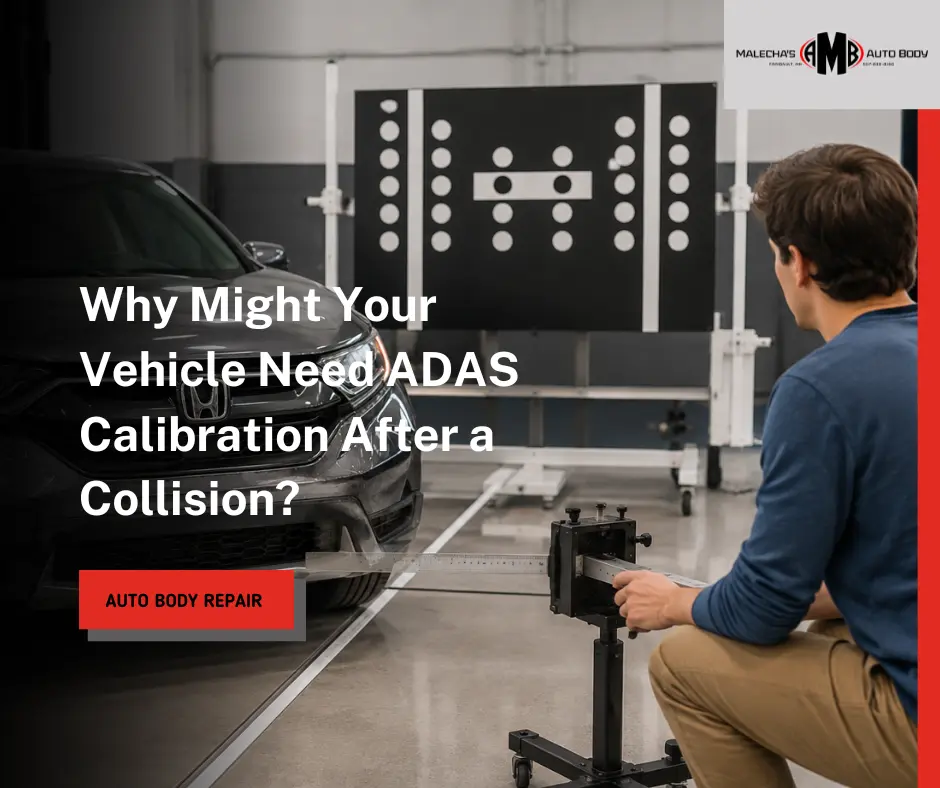
What Is Static ADAS Calibration?
Static calibration is generally performed with the vehicle stationary in a controlled environment.
Depending on the manufacturer, technicians may position specialized targets or reflectors at precise distances and locations relative to the vehicle.
Requirements can include:
- Level surface
- Specified lighting
- Correct tire pressure
- Proper vehicle loading
- Accurate measurements
- Clear space around the vehicle
The calibration equipment and procedure vary by manufacturer and system.
Accuracy matters because targets may need to be positioned according to specific measurements.
What Is Dynamic ADAS Calibration?
Dynamic calibration generally involves driving the vehicle under specified road conditions while diagnostic equipment communicates with the system.
Requirements can potentially include:
- Specific vehicle speed
- Clearly visible lane markings
- Certain road types
- Suitable weather
- Specific driving duration
The vehicle manufacturer determines the procedure.
Traffic, weather, road markings, or other conditions can sometimes affect how quickly a dynamic calibration can be completed.
Can a Vehicle Require Both Static and Dynamic Calibration?
Yes.
Depending on the vehicle and system, the manufacturer may require:
- Static calibration
- Dynamic calibration
- Both
This is why technicians cannot simply choose whichever procedure is most convenient.
They need to identify the vehicle and affected system and follow the applicable OEM information.
The I-CAR Repairability Technical Support resources help collision professionals locate manufacturer-specific repair information.
Is Diagnostic Scanning the Same as ADAS Calibration?
No.
They are related but different procedures.
Diagnostic scanning
A scan tool communicates with vehicle electronic modules to identify information such as:
- Diagnostic Trouble Codes
- System faults
- Communication issues
ADAS calibration
Calibration establishes or verifies the positioning or operation of a camera or sensor according to manufacturer specifications.
A scan cannot automatically substitute for calibration.
Likewise, successful calibration does not necessarily eliminate the need for appropriate diagnostic scanning.
Depending on the vehicle and repair, both may be necessary.
Why Might a Pre-Repair Scan Be Needed?
A pre-repair scan can help technicians understand the electronic condition of the vehicle before repairs begin.
It may reveal diagnostic trouble codes related to:
- Safety systems
- Driver-assistance systems
- Body electronics
- Other control modules
This information can help technicians develop a more complete repair plan.
I-CAR notes that some electronic malfunctions may not necessarily trigger an obvious dashboard indicator, which is one reason collision diagnostics can be important.
Why Might a Post-Repair Scan Be Needed?
A post-repair scan can help technicians identify whether relevant diagnostic trouble codes remain after the physical repairs and applicable electronic procedures have been completed.
Think of it as part of the verification process.
Depending on the vehicle, final procedures might include:
- Post-repair scanning
- ADAS calibration
- Alignment
- System checks
- Road testing
The exact sequence should be based on manufacturer requirements.
If There Is No Warning Light, Is the ADAS System Fine?
Not necessarily.
The absence of a dashboard warning should not be used as the sole evidence that an ADAS system is correctly calibrated.
Some problems may:
- Store diagnostic information
- Affect sensor position
- Require calibration based on the repair operation
without producing an immediately obvious warning.
Calibration requirements are therefore based on the vehicle manufacturer’s procedures, not solely on what the driver sees on the dashboard.
Can ADAS Still Appear to Work When Calibration Is Needed?
Potentially.
A feature appearing to function does not establish that the sensor is operating within manufacturer specifications.
For example, a camera may still:
- Detect lane markings
- Display information
while calibration is required because of a specified repair procedure.
Likewise, radar may still communicate electronically even if its mounting position has changed.
This is why professional verification matters.
Why Do OEM Procedures Matter for ADAS Calibration?
Calibration requirements are vehicle-specific.
Manufacturers determine:
- When calibration is required
- What equipment is necessary
- What preparation is needed
- Whether the procedure is static or dynamic
- What conditions must be met
A technician should therefore research the exact:
- Year
- Make
- Model
- Trim and equipment where relevant
before deciding whether calibration is required.
Malecha’s Auto Body provides information about its manufacturer-focused collision repair capabilities through its OEM certification page.
Why Is Technician Training Important?
Collision technicians now need skills extending well beyond traditional bodywork.
Modern repairs can involve:
- Advanced materials
- Structural repair
- Electronics
- Diagnostics
- ADAS
- OEM repair research
- Calibration requirements
Technology also changes quickly.
A vehicle manufactured today may contain systems that were uncommon or unavailable a decade ago.
Continuing technical education helps repair professionals keep pace with these changes.
Can ADAS Calibration Affect a Collision Repair Estimate?
Yes.
If calibration is required, the repair estimate may include additional operations associated with:
- Diagnostic procedures
- Calibration
- Alignment
- Sensor replacement
- Sensor mounting repair
Sometimes the need for calibration is identified during initial repair planning.
Other times it becomes clearer after:
- Disassembly
- Additional damage discovery
- OEM research
When additional required work is identified, it may appear on a supplemental estimate.
Why Might Calibration Be Added After Repairs Have Already Started?
The complete repair scope is not always known at the initial estimate.
For example, technicians may remove a damaged bumper and discover:
- Broken radar bracket
- Damaged mounting point
- Additional structural damage
That discovery can change both the physical repair and electronic procedures required afterward.
The resulting supplement may include calibration that did not appear on the initial estimate.
That does not necessarily mean someone forgot about ADAS.
The requirement may depend on damage that could not be confirmed until disassembly.
Does Insurance Cover ADAS Calibration?
Coverage depends on the individual policy, claim, repair, and insurer’s evaluation.
When calibration is required as part of collision repair, the repair facility can document:
- Damaged components
- Repair operations
- OEM requirements
- Calibration procedures
Drivers should review their coverage and discuss claim-specific questions directly with their insurer.
For general Minnesota auto insurance information, consumers can consult the Minnesota Department of Commerce.
What Should You Receive After ADAS Calibration?
Documentation can vary by vehicle, equipment, and procedure.
When applicable, ask the repair facility what documentation is available for:
- Diagnostic scans
- Calibration
- Wheel alignment
- Repair procedures
Keep these records with your final repair documentation.
They may be useful if questions arise later about the collision repair or vehicle systems.
What Happens If ADAS Calibration Is Skipped When Required?
If a manufacturer requires calibration after a particular repair, skipping that procedure means the repair process has not followed that requirement.
Because ADAS systems rely on precisely positioned cameras and sensors, an improperly positioned component could potentially affect how a system detects or interprets surrounding conditions.
The exact effect would depend on:
- Vehicle
- System
- Degree of misalignment
This is why calibration should not be treated as an optional add-on when the manufacturer specifies it as part of the repair procedure.
Should You Try to Calibrate ADAS Yourself?
ADAS calibration is not generally a DIY collision repair procedure.
It can require:
- Manufacturer-specific repair information
- Diagnostic equipment
- Calibration targets
- Measurement tools
- Controlled workspace
- Technical training
Even seemingly simple factors such as tire pressure, ride height, floor level, or target positioning can matter during certain calibration procedures.
A qualified collision repair facility should determine the applicable requirements and use the appropriate equipment and process.
How Can You Tell If Your Vehicle Has ADAS?
Check:
- Owner’s manual
- Vehicle settings
- Instrument cluster
- Manufacturer information
You may recognize features such as:
- Adaptive cruise control
- Lane departure warning
- Automatic emergency braking
- Blind-spot monitoring
However, do not rely solely on visible buttons or dashboard menus.
A professional repair facility can identify vehicle equipment as part of collision repair planning.
What Should You Ask Your Body Shop About ADAS?
Useful questions include:
- Does my vehicle have ADAS?
- Which cameras or sensors are located near the damaged area?
- Were any sensors removed?
- Did the collision damage a sensor bracket?
- Does the manufacturer require calibration?
- Will my vehicle need static or dynamic calibration?
- Is wheel alignment required first?
- Will the vehicle receive diagnostic scans?
- Can I receive documentation of completed calibration?
The shop should be able to explain why calibration is or is not included in the repair plan.
Why Should ADAS Be Considered Even After a Minor Collision?
Collision severity is not determined solely by how dramatic the exterior damage looks.
A relatively minor impact can potentially affect:
- Bumper brackets
- Sensor mounting points
- Suspension alignment
- Electronic components
A bumper cover may even return close to its original shape after impact while components underneath remain damaged.
That is why the question should not be:
“Does the car look badly damaged?”
It should be:
“What components were affected, and what does the manufacturer require after repairing them?”
Professional collision repair considers the complete vehicle rather than just the visible exterior.
Frequently Asked Questions
What does ADAS calibration mean?
ADAS calibration is a manufacturer-specified procedure used to establish or verify the proper positioning and operation of certain cameras and sensors used by driver-assistance systems.
Does every collision require ADAS calibration?
No. Requirements depend on the vehicle, systems installed, collision damage, and repairs performed.
Can a minor bumper accident require calibration?
Potentially. If the collision or repair affects radar, sensor mounting, the bumper, surrounding structure, or another calibration trigger identified by the manufacturer, calibration may be required.
Is scanning the same as calibration?
No. Diagnostic scanning communicates with electronic modules and identifies faults or trouble codes. Calibration addresses the positioning or operation of certain cameras and sensors.
Can my vehicle need calibration without an ADAS warning light?
Yes. The absence of a warning light does not by itself establish that calibration is unnecessary. Manufacturer procedures determine when calibration is required.
Why can wheel alignment affect ADAS?
Some systems depend on vehicle geometry and direction of travel. Depending on the manufacturer, calibration may be required after certain alignment, suspension, or steering procedures.
Can windshield replacement require ADAS calibration?
Yes. Vehicles with windshield-mounted cameras may require calibration after windshield replacement according to manufacturer-specific requirements.
Where can I have collision damage evaluated in Faribault, MN?
Malecha’s Auto Body provides professional collision and auto body repair at 190 20th St NW, Faribault, MN 55021, United States.
Make ADAS Part of the Complete Collision Repair Process in Faribault, MN
Modern vehicles combine traditional body structures with cameras, radar, sensors, electronic modules, and sophisticated driver-assistance technology. Because these systems can depend on precise component positioning, restoring the visible collision damage may be only one part of the repair.
Depending on your vehicle and the work performed, OEM procedures may call for diagnostic scanning, wheel alignment, ADAS calibration, or additional electronic verification. The correct requirements should be researched for the specific year, make, model, and affected system rather than assumed based on how severe the accident looks.
If your vehicle has been involved in a collision, visit Malecha’s Auto Body at 190 20th St NW, Faribault, MN 55021, United States. The team provides professional collision repair, auto body repair, and manufacturer-focused repair capabilities supported by its OEM certification programs.
To begin evaluating your vehicle’s visible and potentially hidden collision damage, request an estimate from Malecha’s Auto Body.
