
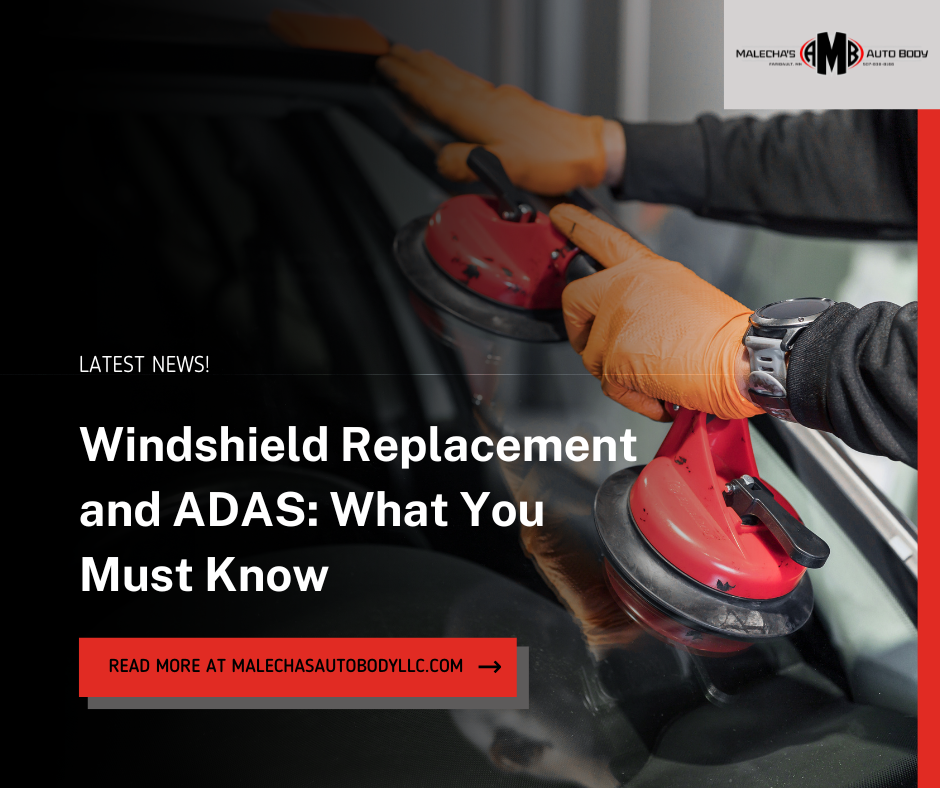
Windshield replacement might seem like a simple repair, but for most modern vehicles, it is one of the most safety-critical procedures performed after a collision. Today’s windshields are no longer just pieces of glass. They are engineered components that support cameras, sensors, and Advanced Driver Assistance Systems. These systems help prevent crashes and protect you and your passengers on the road.
At Malecha’s Auto Body, serving drivers in Faribault and Waseca, Minnesota, we see windshield replacements every week that require far more than just removing glass and installing a new one. Proper windshield replacement involves glass quality, structural integrity, correct installation procedures, adhesive curing, and most importantly, ADAS calibration.
This article explains why windshield replacement matters more than most drivers realize, the hidden risks of cheap or incorrect installations, and how Malecha’s advocates for your safety throughout the entire repair process.
If you want to learn more about our repair capabilities, visit our Auto Body Repair page.
Why Windshield Replacement Is a Safety Critical Repair
The windshield is a structural component of your vehicle. It:
- Supports roof strength
- Helps airbag deployment
- Provides structural rigidity
- Anchors cameras and safety sensors
- Ensures drivers have a clear field of vision
The National Highway Traffic Safety Administration states that windshields play a major role in vehicle crashworthiness.
On modern vehicles, the windshield is also home to forward-facing cameras and sensors that operate your ADAS systems, including:
- Lane keeping assist
- Lane departure warning
- Adaptive cruise control
- Forward collision warning
- Automatic emergency braking
- Traffic sign recognition
- Driver fatigue monitoring
If the windshield is not installed correctly or if the camera is not recalibrated after installation, these systems can malfunction without warning. A vehicle that looks properly repaired may not protect you in a critical moment.
This is why windshield replacement must be performed using OEM procedures, OEM quality glass, and proper calibration.
How Windshield Replacement Affects ADAS Safety Systems
ADAS systems depend on precise camera alignment and correct windshield positioning. Even the slightest deviation in glass angle, thickness, or camera mounting position can cause the system to see the road incorrectly.
The Insurance Institute for Highway Safety has found that incorrect windshield installation can affect how ADAS systems read lane markings and detect vehicles.
Here are examples of what can go wrong when ADAS sensors are not recalibrated:
1. Lane assist may drift or pull unexpectedly
If the camera sees lane lines in the wrong position, the system may guide the car inaccurately.
2. Automatic braking might not activate
Forward collision systems depend on accurate distance measurements. Misalignment affects timing and detection.
3. Blind spot alerts may not trigger
Although mounted elsewhere, blind spot systems rely on correct overall geometry.
4. Adaptive cruise control may misjudge distance
Improper camera alignment can cause the system to react slowly or inconsistently.
5. Airbags may deploy incorrectly
Structural integrity and sensor communication affect deployment timing.
Every one of these issues has life-saving implications. This is why Malecha’s uses OEM procedures, proper equipment, and professional calibration systems to verify that your windshield and safety systems operate exactly as intended.
The Risks of Cheap or Incorrect Windshield Replacement
Many drivers are surprised to hear that low-cost or mobile glass replacements can create significant safety risks. Not all glass is the same, and not all installers follow OEM procedures.
Here are some risks associated with improper replacements.
1. Non-OEM glass may distort or refract camera vision
Camera systems are calibrated for specific glass clarity, thickness, curvature, and optical quality. Aftermarket glass often does not meet OEM optical standards.
2. Incorrect adhesives can affect roof strength
The windshield provides a significant amount of roof support. Wrong adhesives or improper curing can weaken structural integrity.
3. Cameras may not be positioned correctly
Even a slight misalignment creates inaccurate readings.
4. ADAS calibration may be skipped entirely
Many glass installers do not have calibration capability or rely on generic tools that do not meet OEM standards.
5. Insurance companies often push the cheapest option
Insurers may recommend low-cost glass or mobile installation to reduce claim expenses. This can compromise your safety.
At Malecha’s, we advocate for you. We follow strict manufacturer requirements and document every step so insurers understand exactly what your vehicle needs.
Why ADAS Calibration Is Required After Windshield Replacement
Any time the windshield is replaced, the forward-facing camera mounted behind it must be recalibrated. There are no exceptions to this rule because the camera’s angle and distance from the road change when the glass changes.
Most OEMs require:
- Static calibration
- Dynamic calibration
- System verification
- A post-repair scan
Calibration ensures the camera sees the road exactly as the manufacturer intended.
The Auto Glass Safety Council emphasizes that ADAS recalibration is required for almost all windshield replacements on vehicles equipped with safety cameras.
At Malecha’s, calibration is performed in-house using OEM scan tools and precision calibration equipment. This allows full control over accuracy and timing, and ensures the job is done correctly.
Learn more about our diagnostic and repair process by visiting our Collision Repair page.
Malecha’s In House Calibration Protects Your Safety
Not all shops can perform proper ADAS calibration. Some sublet this work to mobile vendors who do not have controlled environments or proper equipment. Others skip the step entirely, which is extremely dangerous.
Malecha’s invests in:
- Professional ADAS calibration systems
- OEM scan tools
- Controlled calibration environment
- Trained technicians
- Structural verification equipment
We never release a vehicle until we confirm the ADAS camera is calibrated, the windshield is correctly installed, and all systems are functioning properly.

This is part of our commitment to customer safety and the reason drivers in Faribault and Waseca trust our work.
How Windshield Replacement Works at Malecha’s
Here is what to expect when your vehicle needs a new windshield after a collision.
1. OEM procedure review
Every vehicle is researched to find the correct installation and calibration requirements.
2. Pre-wash and inspection
We clean and inspect the damaged area to identify potential issues with surrounding components.
3. Removal of the old windshield
Technicians carefully remove the glass to avoid damaging paint, trim, or surrounding structure.
4. Preparation of bonding surfaces
Cleaning, priming, and preparation ensure the adhesive bonds correctly.
5. Installation of OEM or OEM equivalent glass
We use high-quality glass that meets the manufacturer’s optical and structural standards.
6. Adhesive application with correct cure time
Improper curing can weaken the structure. We follow strict timing and environmental requirements.
7. ADAS calibration
Using precision equipment, we recalibrate the forward-facing camera and verify proper system communication.
8. Post scan and quality inspection
We confirm that all modules communicate correctly and that ADAS systems are functioning properly.
Only then is the vehicle ready for safe driving.
How Insurance Companies Impact Windshield Replacement
Glass claims are among the most commonly underestimated repairs in the insurance world. Some insurers direct customers toward the lowest cost option, which may not meet safety or OEM requirements.
Malecha’s advocates for customers by:
- Documenting ADAS requirements
- Providing OEM calibration guidelines
- Explaining the safety implications of cheap glass
- Ensuring insurers approve necessary procedures
- Communicating directly with adjusters
- Protecting customers from unnecessary cost-cutting
You have the legal right to choose your repair shop, and you have the right to safe, OEM correct repairs. Malecha’s ensures those rights are protected.
When You Should Replace Your Windshield After a Collision
Even if damage seems minor, you should replace your windshield if:
- Cracks obstruct the camera view
- The glass is chipped near the camera housing
- Structural integrity is compromised
- ADAS sensors malfunction
- The glass has optical distortion
If you are unsure whether replacement is needed, our technicians can inspect the vehicle and provide clear recommendations.
Frequently Asked Questions About Windshield Replacement and ADAS
1. Do all windshield replacements require ADAS calibration
Yes. If your vehicle has a forward-facing camera or any ADAS feature mounted near the windshield, calibration is required by the manufacturer to ensure proper system performance.
2. Will insurance pay for OEM glass
Insurance companies often cover OEM glass when it is required for safety or ADAS functions. Malecha’s documents these requirements and advocates on your behalf.
3. How long does windshield replacement take
Replacement and calibration can take several hours, depending on adhesive cure time and OEM calibration requirements.
4. Can I drive my vehicle immediately after replacement
Most adhesives require a minimum safe drive time before the vehicle can be operated. We will tell you exactly when it is safe to drive.
5. What happens if calibration is skipped
ADAS systems may not function correctly, putting you at risk. Skipping calibration is unsafe and violates OEM repair procedures.
Schedule Your Windshield Replacement and Calibration
If your windshield was damaged in a collision in Faribault or Waseca, Minnesota, schedule a professional inspection today. Malecha’s ensures your glass, structure, and ADAS systems function exactly as the manufacturer intended.
📞 Call: 507-838-8166
🌐 Schedule an estimate
📍 Faribault, MN
📍 Waseca, MNMalecha’s Auto Body — Experience Matters.
OEM-correct repairs. Customer-first service. Safety-driven results.